Key Takeaways
- AI toy companions provide personalized and adaptive learning experiences for children
- Language learning is more effective through interactive and conversational AI immersion
- Safety and privacy are critical design features in modern educational AI tools
- Combining play with education helps maintain child engagement without the need for screens
The landscape of childhood education is undergoing a massive shift as technology evolves from passive screens to interactive partners. Parents today are constantly seeking tools that don't just occupy their children's time but actively contribute to their cognitive development. An AI toy companion like AURA represents this next frontier, moving beyond simple programmed responses to provide dynamic, intelligent interaction.
Children aged 3 to 12 are at a critical developmental stage where curiosity is at its peak. Traditional toys often fail to keep up with the rapid pace of a child's questions, and screen-based apps frequently lead to passive consumption. AURA solves this by acting as a bridge between play and structured learning, offering a personalized experience that adapts to each child's unique pace and interests.
Educational Benefits of AI Toys
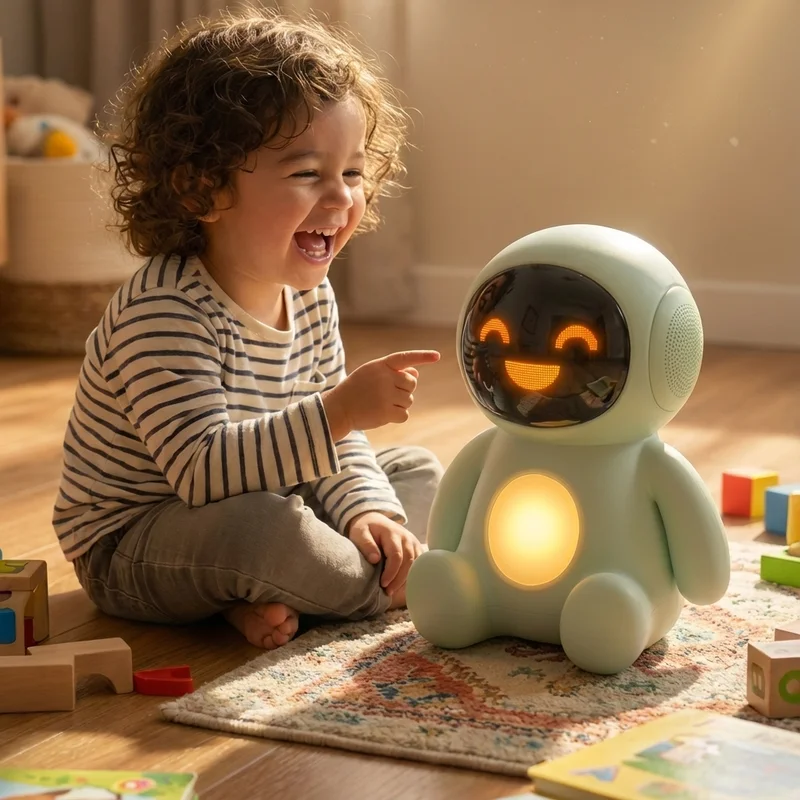
According to research on Educational Technology, interactive tools significantly improve retention rates in young learners. The primary educational benefits of AI toys lie in their ability to provide immediate feedback, which is essential for reinforcing new concepts and correcting mistakes in real-time.
Personalized Learning Paths
Unlike a classroom setting where one curriculum must fit thirty students, an AI companion tailors its lessons to the individual child. If a child excels at math but struggles with vocabulary, AURA adjusts its interaction to provide more support where it is needed most, acting as a dedicated tutor.
Development of Critical Thinking
By encouraging children to ask questions and engage in dialogue, AI toys foster curiosity. Instead of searching for a static answer, the child enters a conversation that requires them to process information and formulate their own inquiries, sharpening their logical reasoning skills.
Ready to transform your child's learning experience?
Discover AURA Today →Language Learning for Kids via AI Immersion
Language learning for kids is most effective when it happens naturally through immersion rather than rote memorization. According to Edutopia research on language acquisition, children who hear and speak a language in a social context develop fluency much faster.
Conversational Fluency Practice
AURA provides a low-pressure environment for children to practice a new language. Unlike talking to a human teacher, children feel less self-conscious about making mistakes with an AI toy, which encourages them to speak more frequently and build their confidence.
Interactive Vocabulary Expansion
The AI toy uses context to teach new words. If a child is playing a game about animals, AURA can seamlessly introduce the foreign language names for those animals, creating a mental link between the object, the play, and the new word.
How to Teach Kids Languages with AI Effectively
Knowing how to teach kids languages with AI requires a blend of technology and parental involvement. While AURA is highly capable, the best results come from setting clear goals and making the toy a part of the daily routine.
- Set a consistent schedule: Even 15 minutes of daily interaction with the AI toy can lead to significant language retention.
- Encourage role-play: Ask your child to teach the AI toy what they learned today, reinforcing their own knowledge.
- Follow the toy's prompts: AI toys often suggest activities that parents can participate in to extend the learning offline.
Boost your child's language skills with the best AI tutor.
Shop AURA AI Companion →Are AI Toys Safe for Kids and Privacy?
A common concern among parents is: are AI toys safe for kids? In an era of data collection, security is paramount. According to the UNICEF guidelines on AI for children, ethical AI must prioritize child safety and data protection.
Data Encryption and Privacy
High-quality AI companions like AURA use end-to-end encryption to ensure that voice data is never accessible to unauthorized third parties. Privacy-first design means the toy focuses on learning interactions rather than gathering personal marketing data.
Parental Controls and Monitoring
Safe AI toys provide parents with a dashboard to monitor progress and set boundaries. This allows parents to see what their child is learning and control the types of topics the AI discusses, ensuring age-appropriate content at all times.
AI Toys vs Traditional Educational Toys
When comparing AI toys vs traditional educational toys, it is important to look at long-term engagement and adaptability. While blocks and puzzles are essential for motor skills, they do not evolve as the child grows.
| Feature | Traditional Toys | AURA AI Companion |
|---|---|---|
| Interactivity | Static / Reactive | Dynamic / Proactive |
| Curriculum | None | Adaptive Tutoring |
| Feedback | Manual | Instant AI Feedback |
| Longevity | Outgrown quickly | Scales with age (3-12) |
Keeping Kids Engaged in Learning with AURA
Keeping kids engaged in learning is the biggest challenge for any parent. AURA uses advanced storytelling and gamification to turn lessons into adventures, ensuring that the child never feels like they are doing "work."
Storytelling and Lesson Help
AURA can help with homework by explaining complex concepts in simple, age-appropriate language. Whether it is a math problem or a history fact, the AI companion can weave the information into a story that makes it more memorable and easier to digest.
Screen-Free Education
One of the greatest benefits of an AI toy companion is that it provides a screen-free educational experience. This reduces eye strain and promotes verbal communication skills, which are often neglected in a digital-first world according to Common Sense Media studies.
Join the revolution in early childhood education.
Order Your AURA AI Today →
Frequently Asked Questions
What age group is AURA designed for?
AURA is specifically designed for children aged 3 to 12. The AI adjusts its vocabulary, tone, and the complexity of its lessons based on the developmental stage and age of the child interacting with it.
How does AURA help with language learning?
AURA uses a conversational approach to teach languages. It engages the child in dialogue, helps with pronunciation, and introduces new vocabulary in a contextual way that mimics natural language acquisition.
Is my child's data private and secure?
Yes, AURA is built with privacy-first protocols. All data is encrypted, and no personal information is sold or shared with third parties. Parents have full control through a dedicated app.
Can AURA help with school homework?
Absolutely. AURA is designed to act as a study buddy. It can explain math concepts, help with science questions, and provide historical context, making it an excellent AI tutor for elementary students.
Does AURA require a screen to operate?
No, AURA is a screen-free device. It communicates primarily through voice and lights, encouraging children to focus on verbal skills and auditory learning rather than staring at a digital display.
The Future of Education is Interactive
As we look toward the future, the role of an AI toy companion in a child's development cannot be overstated. By providing a safe, engaging, and highly personalized learning environment, tools like AURA empower children to take charge of their own education. Whether it is mastering a new language or gaining confidence in school subjects, the benefits are clear.
By integrating an AI companion into your child's life, you are not just giving them a toy; you are giving them a mentor and a friend that grows with them. Explore the possibilities of AURA and see how intelligent play can unlock your child's full potential today.
About the Author

Written by Aurelian Jibleanu, AI Software Engineer
Aurelian Jibleanu is an AI Software Engineer with 5+ years in AI medical applications and smart medical devices & 11+ years of experience building intelligent applications. Specializing in machine learning and medical data science, he's passionate about making AI accessible and practical for everyone. www.dollarappdev.com www.url2ad.com www.edumedic.ai https://apps.shopify.com/seo-auto-write-easy-blog